Predictions of Leonid
activity, peak time, and viewing conditions.
2004: TOUCHING ON TWO DUST TRAILS NOVEMBER 8 +19
Latest news: Jeremie Vaubaillon, working with Peter Jenniskens, have identified an dust trail crossing on November 8, peaking at 23:30 UT, due to dust from the 1001 dust ejecta. The encounter was confirmed by David Asher and Esko Lyytinen. Leonid rates could rise briefly to ~ 50/hour. The meteors would radiate from R.A. = 148.2, Decl., = +25.0 (instead of 153, +22). More information here.
For November 19, Jeremie Vaubaillon, Esko Lyytinen, Markku Nissinen, and David Asher have arrived at a common prediction for this year's 2004 Leonids. It was found that Earth will pass close to two dust trails, those of 1333 and 1733. Any outburst from the 1333 trail will peak at 06:42 UT, November 19, well positioned for U.S.A. observers. Rates will not be high, ZHR = 10 at best. The second 1733 trail will arrive at 21:49 UT, when the rates can go up as high as ZHR = 65. That outburst is best seen in Asia. Even though rates will not be as high as in past Leonid storms, it is important to continue observe these showers to learn how dust is distributed by the parent comet 55P/Tempel-Tuttle.
More information at the IMCCE website
 2003: DUST TRAIL ENCOUNTER NOVEMBER 13
November 13, 13-19 UT (1-3 h wide?), rates peak at
ZHR = 250
Esko Lyytinen and Tom van Flandern (2000, EMP 82-83, 149-166)
have predicted an encounter with the 15 revolution
dust trail of comet 55P/Tempel-Tuttle on 2003, November 13. That
is five days earlier than the usual Leonid showers! Peak
of the shower is around 13 - 19 UT, visible under not so good conditions
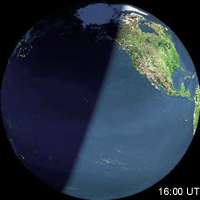
from the western states USA just before dawn (05 - 06:20 a.m. PST),
but better in Alaska (04 - 08:18 a.m. PST), and eastern Asia.
Rates could increase to peak at ZHR = 250 per hour. The
prediction is uncertain, because it assumes that dust is trapped in
the 5:15 (= 1:3) mean-motion resonance with Jupiter, instead of the
5:14 resonance. Because of this difference, the dust will have
completed 14 orbits, when the comet itself has completed 15 orbits.
Only if the particles are trapped in the resonance will the dust stay
away from Jupiter and not be perturbed so much as to disperse. In
addition, a near-full Moon will interfer with observations in the middle
of the night, giving best observing conditions in the early morning hours
when the Moon is low in the sky.
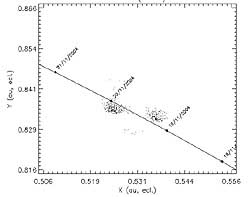
Recently, Jeremie Vaubaillon of the Institut de Mecanique Celeste et de Calcul des Ephemerides, France, confirmed Esko's calculations. Below are the nodes
of the particles of the 1499 and 1533 streams in 2003. "Strange to see
how the streams split", Jeremie adds.
On a down note, Huan Meng reports in a
recent e-mail and in a submitted paper to MNRAS that his calculations
suggest the population index may be rather high (r = 4.9), which means that
the stream could be rich in faint meteors making it hard to observe in the Moon shine.
| 1499 |
most left part: |
middle part: |
most right part |
| distance (AU): |
0.0140520 |
0.00574825 |
0.00260734 |
| node (ecl. J2000): |
236.7439 |
233.9304 | 230.8074 |
| time (UT): |
Nov. 19 13:25 | Nov. 16 18:28 |
Nov. 13 16:02 |
| 1533 |
densest part: |
closest to Earth: |
|
| distance (AU): | 0.0150887 | 0.000360582 |
|
| node (ecl. J2000): | 236.9138 | 236.4930 |
|
| time (UT): |
Nov. 19 17:28 | Nov. 19 07:27 |
= part of Filament (see below) |
LATEST UPDATE (Nov 10):
The latest overview of trail encounters calculated
by J. Vaubaillon, E. Lyytinen, M. Nissinen, and D.J. Asher
(JIMO, vol. 31, 2003, in press) includes other weak trail encounters as well:
----------------------------------------------------------------------
Trail  Model           Da_0   f_M    Time    UT               ZHR
----------------------------------------------------------------------
1499   Asher&McNaught  0.28  ~0.03   Nov 13, 13h15            -
1499   Asher&McNaught  0.26  ~0.8    Nov 13, 18h20            -
1499   Lyytinen        0.28  ~1.6    Nov 13, 16h40 half a day 100
1499   Vaubaillon                    Nov 13, 17h17            120
----------------------------------------------------------------------
1533   Asher&McNaught  0.30  ~0.04   Nov 19, 06h30            -
1533   Lyytinen        0.30  ~0.1    Nov 19, 08h              dozen(s)
1533   Vaubaillon                    Nov 19, 07h28            100
----------------------------------------------------------------------
1333   Asher&McNaught  0.12  ~0.02   Nov 20, 00h50            -
1333   Lyytinen              ~0.02   Nov 20, 01h30            20
1333   Vaubaillon                    Nov 20, 01h26            15
----------------------------------------------------------------------
 736   Lyytinen       -0.008         Nov 22, 21h              10
 736   Vaubaillon                    Nov 22, 22h02             2
----------------------------------------------------------------------
 636   Vaubaillon                    Nov 23, 02h56            10
----------------------------------------------------------------------
1733   Lyytinen        0.11          Nov 19, 00h25        a few dozen?
----------------------------------------------------------------------
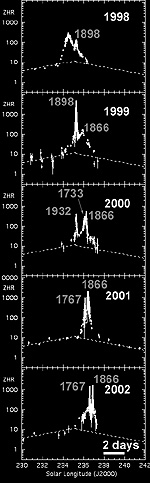
Compilation of Leonid shower rates in the years 1998 - 2002 (logarithmic scale). Individual
dust trail encounters (lasting a few hours at best) are marked. Note that the much
broader
Filament component (causing the "fireball shower" in 1998) was present in all years.
Dust trails and Filament are on top of the annual Leonid shower activity.
Image by Peter Jenniskens.
2003: THE "FIREBALL SHOWER" NOVEMBER 19
November 19, 05:30 UT (1 day wide), rates peak at ZHR = 50
According to Peter Jenniskens and Hans Betlem (2000, ApJ 531, 1161),
many other such old dust trails trapped
in mean-motion resonances tend to form a broad dust trail structure
called the "FILAMENT". The Filament is a sum of contributions from many
returns and the nature of individual dust trails may not be recognized
anymore. In that case, the structure will be very broad, about 1 day
wide and underlays more recent dust trail encounters (see figure).
The Filament was first seen in 1994. The
Filament is expected to stop being visible 10 - 11 years (little less than
1 orbit of Jupiter) after the first sighting in 1994. There is a good chance
that the Filament will return in 2003 (which would span 10 years), but it
may be just beyond the maximum range over which dust
is protected from close encounters
with Jupiter. If still in the protected range, then rates in 2003 could
increase to about ZHR = 50 per hour
(nearly like a Perseid shower, but more rich in bright meteors...).
Peter Jenniskens calculated an expected peak
time around 5.5 UT, November 19, based on the trend observed in 1995-1997
and 1999-2002. This corresponds to solar longitude 236.407 (J2000).
However, in 1994 and 1998 this peak was ~ 0.7 days earlier
for unknown reasons. If the prediction holds, then the best viewing is in the
Americas, but bright meteors can also be seen in other parts of the world
in the nights of Nov. 17/18, 18/19, and 19/20. The Moon will be beyond last
quarter, but can still interfer with the viewing in the early morning hours. On the
other hand, the
Filament tends to be rich in bright meteors and should still give a good showing
if the particles have not been scattered by Jupiter.
Observe away from the Moon, best from a location in the Moon's shadow with as
wide a field of view and good viewing near the horizon.
In addition to this, Jeremie Vaubaillon pointed out that one particular trail, from
1533,
will peak around 07:27 UT, with an expected ZHR of about 100. Joe Rao pointed out
that the previous return, in 1965, showed Filament-type activity in 1971, about as
far from the comet's passage as this year:
- In Sky & Telescope, January 1972, page 57, the 1971 Leonids were
described as producing "moderate" activity with up to 27 per hour for an
observer in North Carolina. Others reported a number of bright fireballs.
- In the February 1973 S&T, page 127, Karl Simmons of Jacksonville, Florida
passed along a report of the 1972 Leonids producing 40 per hour obtained by a
team stationed at Ottawa, Ontario. "The Leonids evidently had their best
display since 1966 this year, and the stream is still active," he wrote.
- And finally, in the March 1975 S&T, page 193, the 1974 Leonids were
described as "startling" by Norman W. McLeod of Punta Gorda, Florida. He had
Leonid rates of up to 40 per hour and about half of the 179 Leonids that he
witnessed left trains, in some cases up to 3 minutes. Another report, from Virginia
Beach cited the train left by a blue fireball that lasted for up to eight
minutes! Keep in mind that this 1974 display occurred more than nine years after
the 1965 perihelion of 55P!
2003: THE ANNUAL SHOWER NOVEMBER 18
November 18, 10ÿý2 UT (few days wide), rates peak at ZHR = 13
Note that the traditional Leonids with ZHR ~ 13 peak at about 10h UT on November 18, a day earlier, but make up a several day wide component. The first Leonids from this component
can be observed as early as the last days of October, and the final Leonids appear on the
last days of November. More information can be found
in this paper from Meteoritics and Planetary Science.
Archive of predictions in 2002.
LEONID STORM OBSERVING GUIDES
Amateur astronomers interested in helping to monitor
the Leonid shower could
make an effort to collect counts of Leonid meteors in 1-minute intervals. It
takes the shower about 2 minutes to cross the United States from the East
Coast to the West Coast. With precise enough data, we can see the shower
sweep accross the country and recognize filamentary structure, if there is any.
Here
is an electronic form to report such flux measurements.
Help with pointing your instruments is given in this
introduction paper by Peter Jenniskens.
A lot more background information on where to point instruments on the sky
during a Leonid encounter can be found in the final chapters of the paper
"Leonid Storm Flux Analysis
from one Leonid MAC Video AL50R" by P. Gural and P. Jenniskens (Download here).
(<<)
EXTERNAL LINKS TO SIMILAR TOPICS:
|